
Hearing Protection Articles
Informational Articles on Hearing Protection
Contents
- Try to imagine, for a moment...
- Some Facts About Hearing Loss
- How loud is your job?
- Additional Facts About Hearing Loss
Try to imagine, for a moment, that to be able to hear your favorite TV shows or your favorite CD you must strain to hear ...
Or that you must play them so loudly everyone else has to leave the room. Try to Imagine that it is not easy hearing your family members from across the room or co-workers from 20 feet away. Or try to imagine that you must also wear a hearing aid to hear your grand kids’ laughter.
For many workers in construction, manufacturing and other industrial settings these situations do not have to be imagined as Unfortunately, they are all too real. They suffer significant hearing loss after 15 to 20 years of being subjected continually to noise from machinery, day-to-day activities, tools and traffic. When you suffer hearing loss, this has a dramatic impact on your quality of life and also can pose safety problems on the job and off the job.
Fortunately, through a combination of quieter equipment, hearing conservation programs, and use of proper hearing protection, hearing loss in industrial settings and construction is completely preventable.
Hearing protection products from ISEA members meet the EPA Noise Control Act of 1972 (40 CFR 211) and set the world standard for reducing harmful noises while allowing workers to stay in touch with their surroundings and communicate effectively with co-workers. Click on the links below to find products of these types of hearing protectors:
These type come on a flexible plastic band that is worn under the chin while the protectors are in the ears. While the protectors are not in use, the band can be left resting around the neck. These bands are designed for convenience in work areas with varying noise levels.
With this type of headsets, the wearer canblock unwanted noise while at the same time be able to communicate clearly with co-workers. With special microphones in the headset, it suppress environmental noise to aid in two-way communications.
The purpose of these caps is to seal the opening to the ear without entering the ear canal. These are very similar to band-type hearing protectors, as they usually come on a band that can be placed around the neck when the caps are not in use. These allows for convenience in work areas with varying noise levels.
Ear muffs are great in suppressing unwanted noise by completely covering the outer ear.
The disposable plugs are designed to be inserted into a person’s ear canal. They expand and conform to the shape of each individual’s ear canal.
The reusable plugs are made from silicone, plastic or rubber and are usually pre-molded and are available in several different sizes. These are sometimes refered to as "Christmas tree plugs" because of their appearance. To help keep them clean when not in use, they often come with a carrying case.
Additional Facts About Hearing Loss
SENSORINEURAL and CONDUCTIVE are the two most common types of hearing loss that occur in adults.
Sensorineural hearing loss is the result of damage to the inner ear and accounts for over 90% of hearing loss in adults. This type of hearing loss is generally permanent.
Causes of Sensorineural hearing loss include:
- Deterioration of hair cells due to aging or exposure to loud sounds.
- Deterioration of nerves pathways that transmit signals to the brain, this is most commonly caused by a tumor pinching the nerves
- Trauma to the head
- Infection that reaches the inner ear
- Heredity
Sensorineural hearing loss is irreversible– and totally unnecessary as it is caused by loud, sudden noises and are more damaging to hearing than regular and extended exposure to loud sounds over a period of time
The general thought is that loud noises which are in excess of 90 decibels are harmful to hearing over prolonged exposure. But this can be prevented by using the correct ear protection thus preventing needless and permanent damage to hearing.
Conductive hearing loss: This most commonly occurs when there is damage or blockage in the outer or middle ear, thus preventing sound from traveling normally through the ear canal to the inner ear. Fortunately this type of hearing loss can often be corrected.
Causes of Conductive hearing loss include:
- Fluid build up, often due to ear infection
- Ear wax
- Perforated ear drum
How loud is your job?
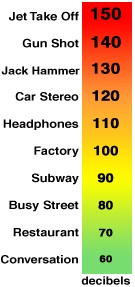
The consensus is that noise exposures greater than 85 db may be responsible for hearing loss. Here are some general estimates of some work-related noises, according to the National Institute for Occupational Safety and Health (NIOSH), are listed below.
Where does your job fit in this list?
• Rocket launch - 180 dB
• 12-gauge shotgun - 165 dB
• Jet engine at takeoff - 140 dB
• Ambulance siren - 120 dB
• Pneumatic percussion drill - 119 dB
• Hammer drill - 114 dB
• Chain saw - 110 dB
• Continuous miner - 108 dB
• Bulldozer; spray painter - 105 dB
• Impact wrench - 103 dB
• Hand drill - 98 dB
• Tractor - 96 dB
• Belt sander - 93 dB
• Hair dryer; power lawnmower - 90 dB
• Ringing telephone - 80 dB
• Normal conversation - 60 dB
Additional Facts About Hearing Loss
What is a Temporary Hearing Loss or (Temporary Threshold Shift)?
Normal hearing will usually return after a rest period away from all sources of intense or loud noise, this is known as a temporary hearing loss, The recovery period may vary by minutes, hours, a day or perhaps even longer. Some of the causes of a temporary hearing loss may occur when hair cells in the inner ear have been bent by vibrations and need time to bounce back, or when the fluid in the inner ear has changed chemically because of over-stimulations, and needs time to revert to its original composition.
What is a Permanent Hearing Loss (Permanent Threshold Shift)?
In contrast a permanent hearing loss is the result of hair cells or nerve destruction within the cochlea. Once these important parts of the hearing process are destroyed, they can never be restored or regenerated. The resulting permanent hearing loss, also referred to as permanent threshold shift (PTS), can range from slight to total hearing loss.
There are factors that determine the degree and extent of hearing loss:
- Type of Noise – continuous, intermittent, impact, high or low frequency
- Intensity of Noise – level of loudness
- Duration of Exposure – length of time subjected to noise, and over time how often subjected to noise
- Type of Noise Environment – enclosed, open, reflective surfaces
- Distance from Ears to the Source of Noise – earphones in the ear, centimeters from the ear, meters, etc.
- Physical position/posture relative to the noise source
- Age of listener
- Individual Susceptibility
- General Health of listener
- Number of other Exposures to Noise – at home, in the workplace, during recreational/leisure activities, etc.